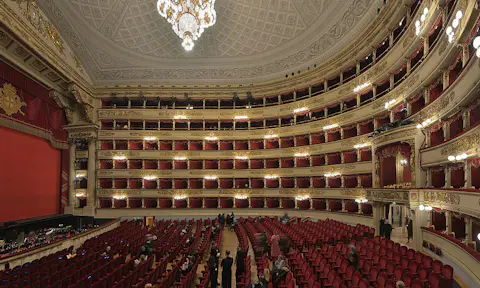
While Teatro alla Scala is not located directly in Venice, it is an iconic landmark in Milan, a short and convenient journey from Venice, offering an unmissable cultural experience for visitors to Northern Italy. Renowned globally as one of the leading opera and ballet theatres, La Scala has captivated audiences for centuries with its exquisite performances and breathtaking interior.
A visit to La Scala offers more than just a show; it's a journey into the heart of Italian artistic heritage. Marvel at the opulent décor, the intricate frescos, and the sheer grandeur that defines this legendary venue. From its hallowed stage, countless legendary artists have graced the world with their talent.
Our tickets.venice.it platform also provides access to premier cultural experiences beyond the immediate Venetian lagoon. Consider a day trip or an extended stay to Milan to immerse yourself in the magic of Teatro alla Scala, an essential pilgrimage for any admirer of opera and classical music.
Even if you're primarily based in Venice, a quick train ride can transport you to this theatrical marvel. Enhance your Italian itinerary by including a visit to Teatro alla Scala, a true jewel in the crown of European culture.


Practical Info
FAQ
What to See
Teatro alla Scala
Main Auditorium
Marvel at the stunning red and gold interior of the main theatre hall, with its five tiers of boxes and galleries, a true masterpiece of neoclassical design.
La Scala Theatre Museum
Explore the extensive museum collection featuring historical costumes, stage models, musical instruments, and portraits of legendary artists who have graced La Scala's stage.
Stage View (when available)
Gain a unique perspective by occasionally seeing the grand stage from one of the boxes, offering a glimpse into the mechanics and grandeur of a working theatre.
Verdi Monument
Discover the monument dedicated to Giuseppe Verdi, one of Italy's greatest composers, whose works are inextricably linked with La Scala's history.
Foyer and Grand Staircase
Admire the elegant foyer and the majestic grand staircase, setting the tone for the lavish interiors and welcoming renowned guests for centuries.
Permanent Exhibitions
Delve deeper into the history of opera and ballet through various permanent exhibitions within the museum, showcasing artifacts related to famous productions and artists.
History
The story of Teatro alla Scala begins in 1776, when the Royal Ducal Theatre was destroyed by fire. Empress Maria Theresa of Austria commissioned Giuseppe Piermarini to design a new theatre, which was built on the site of the former Church of Santa Maria della Scala, hence its name. Opened on August 3, 1778, with Antonio Salieri's opera Europa riconosciuta, it immediately became a symbol of Milanese cultural life.
Throughout the 19th century, La Scala became the stage for many of Italy's greatest operatic compositions, particularly those of Gioachino Rossini, Vincenzo Bellini, Gaetano Donizetti, and Giuseppe Verdi. Verdi, in particular, had a long and occasionally tumultuous relationship with La Scala, often premiering his masterpieces here, including Nabucco, which was a pivotal work for Italian nationalism.
The theatre has undergone several significant renovations and reconstructions. During World War II, it suffered extensive damage from Allied bombings in 1943. However, it was meticulously rebuilt and reopened in 1946 with a legendary concert conducted by Arturo Toscanini, symbolizing Milan's resilience and its commitment to operatic tradition.
In the early 21st century, La Scala underwent a major, multi-year renovation project from 2002 to 2004, designed to modernize its facilities while preserving its historical integrity. This ambitious undertaking ensured the theatre continues to meet the demands of contemporary productions and audiences, maintaining its status as a world leader in opera and ballet.
Today, Teatro alla Scala remains a beacon of artistic excellence, attracting the finest performers, conductors, and directors from around the globe. Its rich history is intertwined with the evolution of opera itself, making it not just a venue, but a living museum of musical and theatrical genius.
🎟️ Book tickets for Teatro alla Scala
Book now ↗Book now ↗